Roman opus: understanding paving Roman opus in natural stone
What is Roman opus?
L'Roman opus is a laying method inherited from Antiquity, based on the assembly of tiles of different formats according to a precise layout. Unlike regular laying, this method is not based on a simple repetitive pattern, but on alternating dimensions that create a natural visual rhythm.
This technique was widely used in Roman architecture, and has been adopted over the centuries in traditional stone construction. Today, Roman opus is appreciated for its ability to structure surfaces without rigidity and to enhance the material.
Roman opus paving: principle and visual interpretation
Visit opus romain paving is based on a play of proportions between several slab formats. Each element finds its place in an overall composition that avoids excessively strict alignments. This organization gives the floor a lively, balanced appearance.
This type of installation is particularly well suited to natural stone, whose nuances and irregularities reinforce the effect of depth. The eye can move freely over the surface, without being constrained by an overly pronounced geometry.
Natural stones for Roman opus
The success of a Roman opus depends largely on the choice of material. Limestone, with its texture and ability to come in a variety of formats, is particularly well suited to this type of installation.
Collections such as Burgundy tiles provide an ideal base for consistent opus romain paving, both indoors and out.
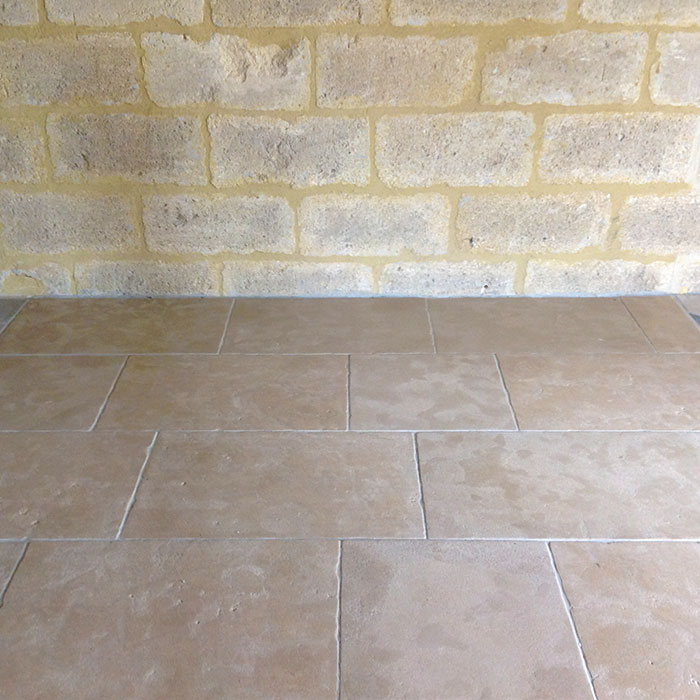
Roman opus paving in antique Burgundy slabs
Visit old paving stones from Burgundy are particularly sought-after for Roman opus. Their natural patina and honed edges lend an immediate authenticity to floors.
References such as antique Burgundy tilesthe Burgundy Stone Flooring or the ancient slab from Burgundy create rich, nuanced soils.
Roman opus and natural stone paving
Roman opus is not limited to Burgundy stone. Other limestones can also be used, provided they are available in a range of formats compatible with the layout.
With this in mind, the natural stone flooring offers great compositional freedom, particularly with regional stones such as paving Dordogne.
Interior and exterior uses of Roman opus
Roman opus paving is used both indoors and outdoors. Indoors, it structures living rooms, kitchens and circulation areas. Outdoors, it is appreciated for terraces and courtyards, where it blends naturally with its surroundings.
Its durability and timeless appeal make it a lasting choice, capable of withstanding the test of time without losing its aesthetic coherence.
Installation and project support
Laying Roman opus requires rigor and anticipation. The layout must be defined in advance to ensure visual balance across the entire surface. The preparation of the substrate and the choice of joints also play an essential role.
To study your opus romain paving project and choose the right materials, we can provide you with assistance via the page contact.
 Français
  English