
Opus Roman Paving and Natural Stone Flooring
What is opus roman paving
Opus roman is a traditional stone laying pattern originating from ancient Roman construction techniques. Instead of using identical tiles arranged in a strict grid, this method combines several slab sizes according to a defined layout. The result is a balanced composition that appears natural while still maintaining geometric harmony.
This technique has been used for centuries in European architecture, particularly in historic buildings where stone floors were designed to last for generations. Today, opus roman paving remains highly valued because it brings both structure and visual movement to a surface without appearing overly repetitive.
The principle of opus roman paving
Opus roman paving relies on combining different slab dimensions to create a repeating but non-uniform pattern. Unlike standard tile layouts, the joints do not form continuous straight lines across the surface. This creates a softer visual rhythm that emphasizes the natural qualities of stone.
Because of this balanced composition, opus roman paving works well in large surfaces such as living rooms, courtyards, terraces, or entrance halls. The layout helps avoid monotony while maintaining architectural coherence.
Natural stone materials suitable for opus roman
The success of an opus roman floor depends largely on the stone selected. Limestone is particularly well suited because it can be cut into multiple formats while maintaining consistent texture and durability.
Collections such as Burgundy stone paving are ideal for creating authentic opus roman layouts thanks to their natural tone variation and traditional character.
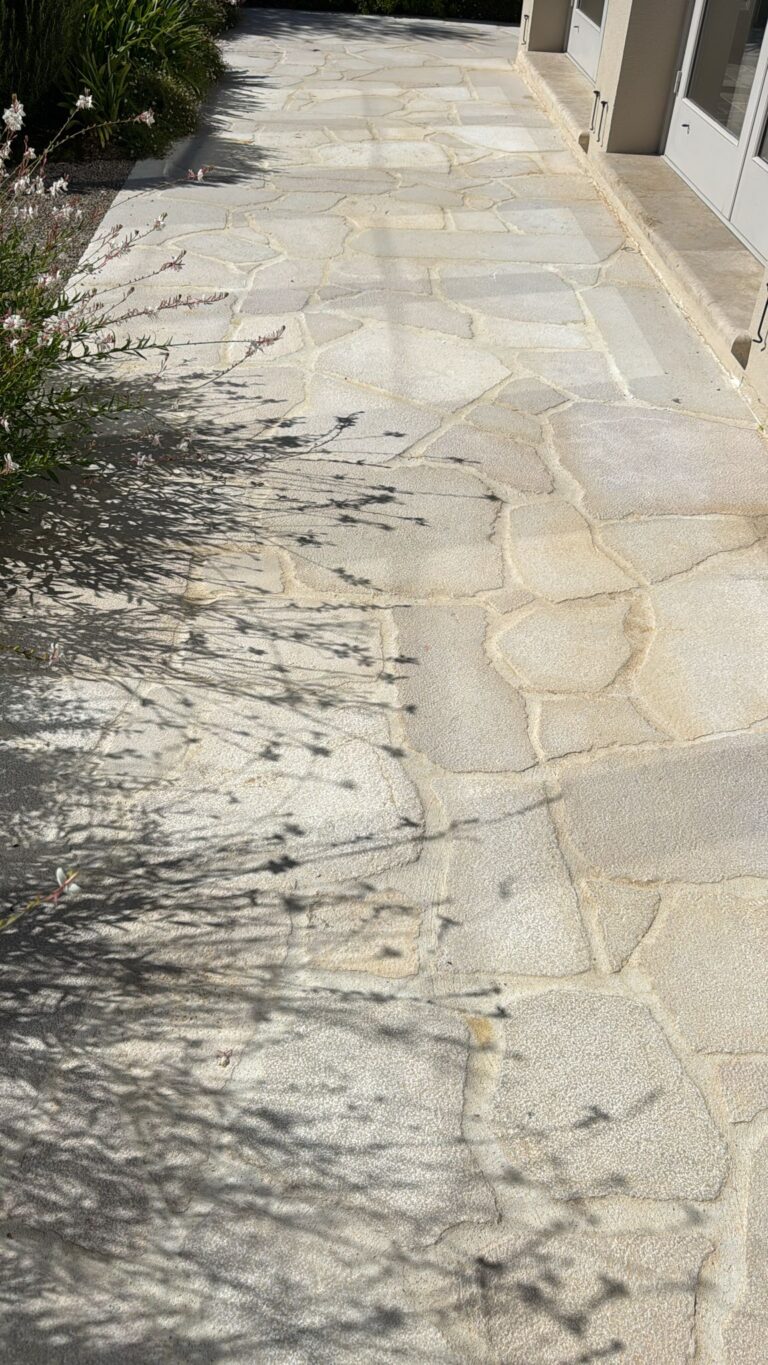
Burgundy limestone and opus roman layouts
Burgundy limestone is widely used in traditional French architecture and is particularly compatible with opus roman paving. Its soft texture and subtle color variations enhance the visual depth of the pattern while maintaining a refined appearance.
Examples such as Dordogne stone paving show how natural limestone slabs can create floors that are both durable and architecturally expressive.
Interior and exterior applications
Opus roman paving is extremely versatile and can be used both indoors and outdoors. In interiors, it works particularly well in kitchens, entrance halls, and large living areas where natural stone adds warmth and texture.
Outdoors, this pattern is often used for terraces, courtyards, and garden pathways. Its irregular layout integrates naturally into landscaped environments and complements traditional architecture.
Installation principles
Installing opus roman paving requires careful planning and preparation. The layout must be defined in advance so that the different slab sizes are distributed evenly across the surface. This ensures that the pattern remains balanced and visually harmonious.
Because natural stone slabs can vary slightly in thickness and tone, installation is often guided by visual alignment rather than strict measurement.
A timeless natural stone flooring solution
Opus roman paving remains one of the most timeless natural stone flooring techniques. Its combination of multiple slab formats creates a rich and balanced composition that enhances both traditional and contemporary architecture.
If you would like guidance on choosing the right stone for your project, our team is available through the contact page.
 Français
  English